

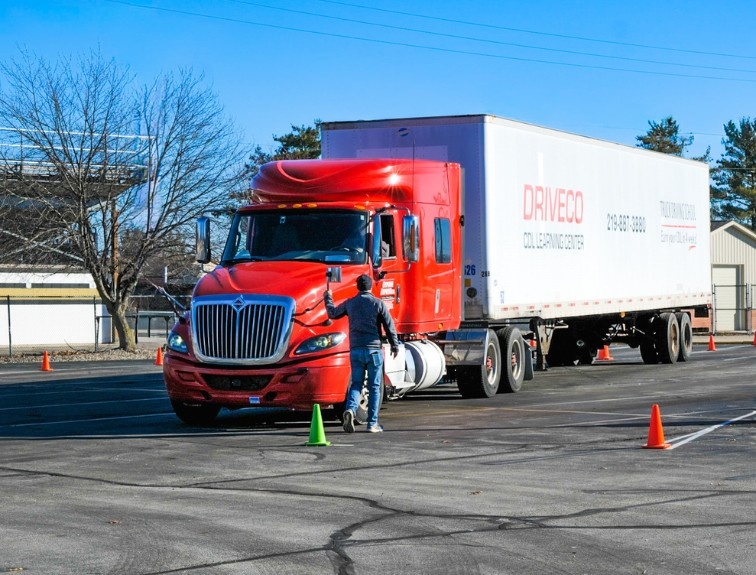
Getting a CDL in Indiana requires meeting specific state and federal requirements, but the process follows a clear path. Applicants must meet age and residency criteria, obtain a Commercial Learner’s Permit (CLP), complete an approved Entry-Level Driver Training (ELDT) program, and pass a three-part skills test. This guide covers each step in detail.
Step 1: Meet Basic Eligibility Requirements
Several requirements must be satisfied before applying for a commercial learner’s permit. These criteria come from both Indiana law and federal regulations.
Age Requirements
Applicants must be at least 18 years old to obtain a CDL or CLP in Indiana. Drivers between 18 and 21 are limited to intrastate operations only, meaning they may only operate commercial vehicles within Indiana’s borders. Drivers must be at least 21 years old to transport goods or passengers across state lines.
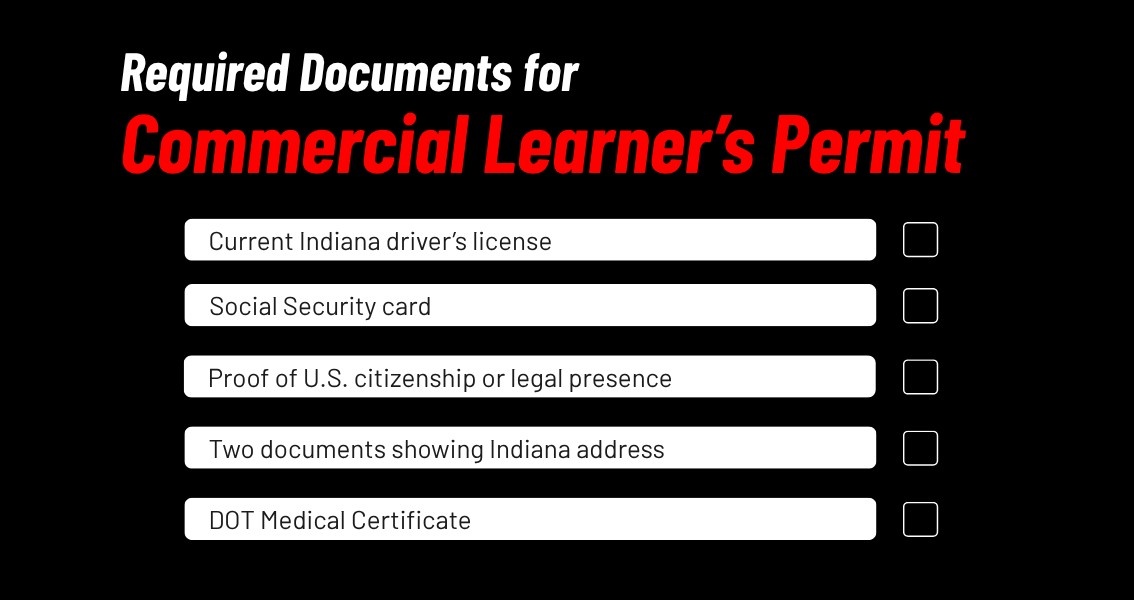
Current Driver’s License
Applicants must hold a valid Indiana driver’s license for at least one year before applying for a CDL.
Proof of Legal Status
Applicants must prove lawful status in the United States. Acceptable documents include a passport, birth certificate, or Certificate of Naturalization. Indiana residency must also be verified with documents such as bank statements or utility bills.
DOT Physical Examination
Every CDL applicant must pass a Department of Transportation (DOT) physical examination, or the DOT Physical, administered by an FMCSA-certified medical examiner. The exam checks vision, hearing, blood pressure, and overall fitness to operate commercial vehicles.
The examining physician submits the Medical Examiner’s Certificate to the National Registry, which forwards the information electronically to the Indiana BMV. Applicants must also provide the BMV with a valid Medical Examination Report and Medical Examiner’s Certificate.
Driving History Review
Indiana requires applicants to request an examination of past vehicle crashes from the Indiana State Police. This review confirms an acceptable driving history before a commercial motor vehicle license can be issued.
Step 2: Obtain a Commercial Learner’s Permit
The Commercial Learner’s Permit allows applicants to practice driving commercial vehicles under supervision while preparing for the final skills test.
Vision and Knowledge Tests
Vision screening takes place at the BMV branch during the application visit. Applicants must have at least 20/40 visual acuity in each eye. Those who do not pass the initial screening receive a referral to an eye doctor and may return with corrective documentation.
Knowledge test requirements depend on which CDL class and endorsements the applicant is pursuing. All applicants take the General Knowledge exam. Class A candidates must also pass the Combination Vehicles test. Applicants seeking to operate vehicles with air brake systems must take the Air Brakes test as well. Test scores remain valid for one year.
Applicants who fail an exam must wait until the next business day before retesting.
CLP Fees and Permit Details
The commercial learner’s permit costs $17.00. The permit remains valid for one year. Indiana law requires applicants to hold the CLP for at least 14 days before scheduling the CDL skills test.
While holding the permit, applicants can only operate commercial vehicles when accompanied by a qualified CDL holder who has the proper class and endorsements for that vehicle type. The permit does not allow passenger transportation to supervisors, trainees, or examiners, and prohibits hauling hazardous materials.
Step 3: Complete Required Training and Practice
Enroll in an Registered CDL Training Program
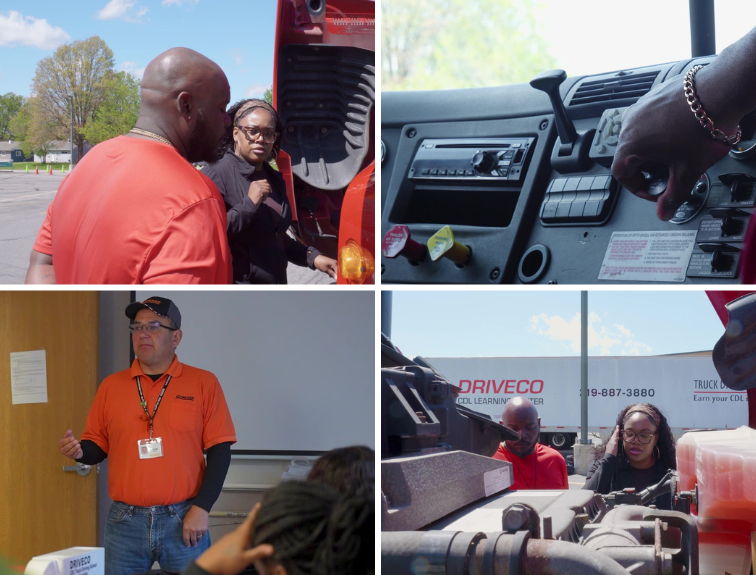
Indiana has several training options available that follow the Entry-Level Driver Training (ELDT) mandate. DriveCo CDL Learning Center maintains campuses in five different locations throughout Indiana. Training typically includes 160 hours of instruction covering classroom theory and behind-the-wheel practice.
Entry-Level Driver Training Requirements
Federal regulations established ELDT requirements effective February, 2022. These rules apply to:
- Individuals obtaining a Class A or Class B CDL for the first time
- Upgrading from Class B to Class A
- Acquiring hazardous materials, passenger, or school bus endorsements for the first time.
Training must come from providers listed on the FMCSA Training Provider Registry. The regulations are not retroactive; individuals who obtained a CLP before that date are exempt.
Practice Driving with the CLP
Applicants must hold their CLP for at least 14 days before scheduling the CDL skills test. This period should be used to practice with an experienced CDL holder across a variety of driving scenarios.
Select a CDL Class
Applicants should choose the license class that matches their career goals.
- Class A authorizes operation of vehicle combinations with a GVWR of 26,001 pounds or more, provided the towed vehicle exceeds 10,000 pounds
- Class B permits driving single vehicles with a GVWR of 26,001 pounds or more, or towing vehicles under 10,000 pounds.
- Class C covers vehicles designed to transport 16 or more passengers or carry placarded hazardous materials.
CDL Endorsements
Six primary endorsements expand driving authorization:
- H – Hazardous materials transport
- N – Tank vehicles
- P – Passenger transport
- S – School bus operation
- T – Doubles or triples
- X – Combined hazardous materials and tanker authorization
Step 4: Pass the Skills Test and Receive the CDL
Scheduling the Skills Test
Once the applicant has held the CLP for at least 14 days, the skills examination can be scheduled. Appointments must be booked at least two days in advance with a BMV-authorized third-party testing site. The test may only be taken once per business day.
The Three-Part Skills Test
The CDL skills test includes three components, all conducted in a vehicle representative of the desired license class:
- Pre-trip inspection – Tests knowledge of vehicle components and safety procedures
- Basic control skills – Evaluates the ability to maneuver in confined spaces
- Road test – Assesses driving performance in real traffic conditions
Testing sites send results directly to the BMV electronically. Test results remain valid for one year.
Receiving the CDL
After passing all three test components, applicants visit any Indiana BMV branch to receive their CDL. The license fee is approximately $35.00. The CDL remains valid for four years.
Transferring a CDL from Another State
Applicants who already hold a CDL from another state must pass the general knowledge written exams and surrender their previous license. Those with a hazardous materials endorsement must retest and obtain threat assessment approval. Transfers must be completed within 30 days of establishing Indiana residency.
Conclusion
Obtaining a CDL in Indiana follows a defined process: meeting eligibility requirements, securing a commercial learner’s permit, completing Entry-Level Driver Training, and passing the three-part skills test. The process typically spans several weeks and leads to stable employment in Indiana’s trucking industry. Candidates who prepare thoroughly and train with an FMCSA-approved program are well-positioned to pass the skills test and begin a commercial driving career.
FAQs
What are the basic age requirements to get a CDL in Indiana?
Applicants must be at least 18 years old to obtain a CDL in Indiana. Drivers under 21 are limited to intrastate (within Indiana) driving only; interstate driving requires the driver to be at least 21.
How long does the CDL process take in Indiana?
The timeline varies, but most applicants complete the process in several weeks. CDL training programs in Indiana typically run two to five weeks, and applicants must hold their CLP for at least 14 days before taking the skills test.
What does the CDL skills test include?
The skills test has three parts: a pre-trip vehicle inspection, a basic control skills assessment, and an on-road driving test. All three components must be passed in a vehicle that matches the desired CDL class.
What is the difference between CDL Class A, B, and C?
- Class A covers vehicle combinations with a GVWR of 26,001 pounds or more where the towed vehicle exceeds 10,000 pounds
- Class B covers single vehicles at 26,001 pounds or more, or those towing vehicles under 10,000 pounds
- Class C covers vehicles transporting 16 or more passengers or carrying placarded hazardous materials.
Is Entry-Level Driver Training required for all CDL applicants in Indiana?
Yes, ELDT is required for anyone obtaining a Class A or Class B CDL for the first time, upgrading from Class B to Class A, or adding certain endorsements for the first time. Training must come from a provider listed on the FMCSA Training Provider Registry.
How much does it cost to get a CDL in Indiana?
The CLP fee is $17.00 and the CDL license fee is approximately $35.00. Training program costs vary by provider and are separate from state fees.
Can an Indiana CDL be transferred from another state?
Yes. Out-of-state CDL holders must pass the general knowledge written exams, surrender their previous license, and complete the transfer within 30 days of establishing Indiana residency. Those with a hazardous materials endorsement must also retest and obtain threat assessment approval.
Are There Additional CDL Rules in Indiana?
Yes. Indiana passed House Bill 1200 in 2026 following a series of fatal crashes involving improperly licensed commercial operators. The law gives the Indiana BMV authority to revoke non-domiciled CDLs when federal agencies provide credible information that a driver lacks valid legal authorization. It also requires all CDL applicants to demonstrate English proficiency in areas such as reading road signs, communicating with law enforcement, and completing required reports. For a full breakdown of these changes, see Indiana Senate Tightens CDL Rules.