
Indiana truck drivers earn a median wage of about $60,290 a year, according to the U.S. Bureau of Labor Statistics. The drivers at the top of the pay scale tend to have three things in common. They haul freight that takes extra skill or carries more risk, they hold the right CDL endorsements, and they have a few years of safe driving behind them.
This guide covers the types of truck driving jobs that tend to pay the most in Indiana, the endorsements that qualify drivers for them, and how new drivers can work toward those roles. Pay depends on the carrier, the freight, the driver’s experience, and the location. Any figures here describe ranges where many drivers fall, not a promise of what one driver will earn.
Table of Contents:
- What Makes a Truck Driving Job Pay More
- Highest Paying Truck Driving Jobs in Indiana
- How Route Type Affects Pay
- Indiana Industries That Need Specialized Drivers
- What About Owner-Operators?
- How New Drivers Build Toward Top Pay
- Frequently Asked Questions
What Makes a Truck Driving Job Pay More
Carriers pay more when a job asks more of the driver. Four factors explain most of the difference between an average paycheck and a top one.
- Miles and time away from home. Many drivers are paid by the mile, so more miles usually means more pay. This is a big reason long-haul work often pays more than local routes.
- Freight that carries more risk. Hazardous materials, liquids that shift inside a tank, and oversized loads all take extra training and care. Carriers pay more for drivers who can handle them safely.
- Endorsements on the CDL. Some freight legally requires an endorsement. Fewer drivers hold these endorsements, which keeps demand for them high.
- Experience and safety record. Many specialized carriers ask for one to two years of experience and a clean driving record before they hire. Insurance requirements are a large part of that rule.
In Indiana, truck driver pay also shifts by experience level and metro area, with the Northwest Indiana and Indianapolis areas reporting some of the highest wages.
Highest Paying Truck Driving Jobs in Indiana
The jobs below tend to pay above the state median because they need extra skill, an endorsement, or more time on the road. Exact pay varies widely by carrier, so drivers should compare offers side by side.
Hazmat Drivers
Hazmat drivers haul chemicals, fuel, industrial gases, and other regulated materials. The job requires a hazmat endorsement, a federal background check, and close attention to rules for placards, loading, and routes. Because the risk is higher and fewer drivers qualify, hazmat work is often near the top of the pay scale.
Tanker and Fuel Delivery Drivers
Tanker drivers haul liquids such as milk, chemicals, and fuel. Liquid cargo moves inside the tank, which changes how the truck brakes and turns, so the work requires a tanker endorsement. Fuel delivery to gas stations requires both the hazmat and tanker endorsements, and it is one of the better-paying local jobs a driver can find.
Oversize and Heavy Haul Drivers
Heavy haul drivers move loads that are too wide, tall, or heavy for a standard trailer. Common examples include construction equipment, large machinery, and wind turbine parts. These jobs do not need a special endorsement, but they require permits, careful route planning, and usually several years of experience.
Flatbed Drivers
Flatbed drivers haul steel, lumber, building materials, and machinery on open trailers. The work is more physical than dry van driving because drivers secure and tarp their own loads. That extra skill and effort often leads to higher pay than standard freight.
Doubles and Triples Drivers
These drivers pull two or three trailers at once, often for less-than-truckload (LTL) carriers. The work requires a doubles/triples endorsement and steady handling skills. Many LTL jobs also run on set schedules, which can mean regular home time.
Team Drivers
Team drivers share one truck and take turns driving so the truck keeps moving. Since the truck covers far more miles each week, each driver often earns more than they would driving solo. The trade-off is long stretches on the road with a partner in close quarters.
Private and Dedicated Fleet Drivers
Private fleet drivers work for a company that hauls its own products, such as a retailer or manufacturer. Dedicated drivers run regular routes for one customer. Industry surveys show private fleets tend to pay above average and keep drivers longer, though these jobs often ask for more experience.
Quick Comparison
| Job Type | Endorsement Needed | Common Route Type |
|---|---|---|
| Hazmat | H | OTR or regional |
| Tanker | N | Regional or local |
| Fuel delivery | X (H and N combined) | Local |
| Oversize and heavy haul | None, but permits required | OTR or regional |
| Flatbed | None | OTR or regional |
| Doubles and triples | T | Regional or linehaul |
| Team driving | Varies by freight | OTR |
| Private and dedicated fleet | Varies by freight | Regional or local |
How Route Type Affects Pay
Over-the-road (OTR) driving usually pays the most of the three main route types, followed by regional and then local. The reason is simple: OTR drivers log the most miles and spend the most time away from home.
Route type is only part of the picture, though. A local fuel delivery driver with an X endorsement may earn more than a regional dry van driver. A regional flatbed driver may out-earn an OTR driver hauling standard freight. Endorsements and freight type often matter as much as distance.
Drivers weighing OTR, regional, and local jobs should also think about home time, schedule, and how much physical work they want.
Indiana Industries That Need Specialized Drivers
Indiana’s mix of manufacturing, energy, and farming creates steady demand for drivers with endorsements and specialized skills. The state’s location at the crossroads of I-65, I-69, I-70, and I-74 also makes it a major hub for freight moving across the Midwest.
| Region | Freight in Demand | Nearby DriveCo Campus |
|---|---|---|
| Northwest Indiana | Steel, refinery products, and chemicals (flatbed, tanker, hazmat) | Gary, La Porte |
| North-central Indiana | RV and trailer manufacturing (flatbed, oversize) | La Porte |
| Central Indiana | Distribution, pharmaceuticals, and manufacturing (dry van, hazmat, LTL) | Indianapolis, Noblesville |
| West-central Indiana | Agriculture and manufacturing (tanker, flatbed) | Terre Haute |
| Southern Indiana | Furniture, auto parts, and river port freight (flatbed, dry van, tanker) | Evansville, Jasper |
Farming adds demand statewide. Grain, livestock, and milk all need drivers, and milk and liquid fertilizer often move by tanker.
What About Owner-Operators?
Owner-operators can bring in more total revenue than company drivers, but they also take on the costs and risks of running a business. They pay for their own truck, fuel, insurance, maintenance, permits, and taxes, and a slow month or a major repair comes out of their own pocket.
Most owner-operators spend years as company drivers first. That time builds the driving record, business knowledge, and savings the role demands.
How New Drivers Build Toward Top Pay
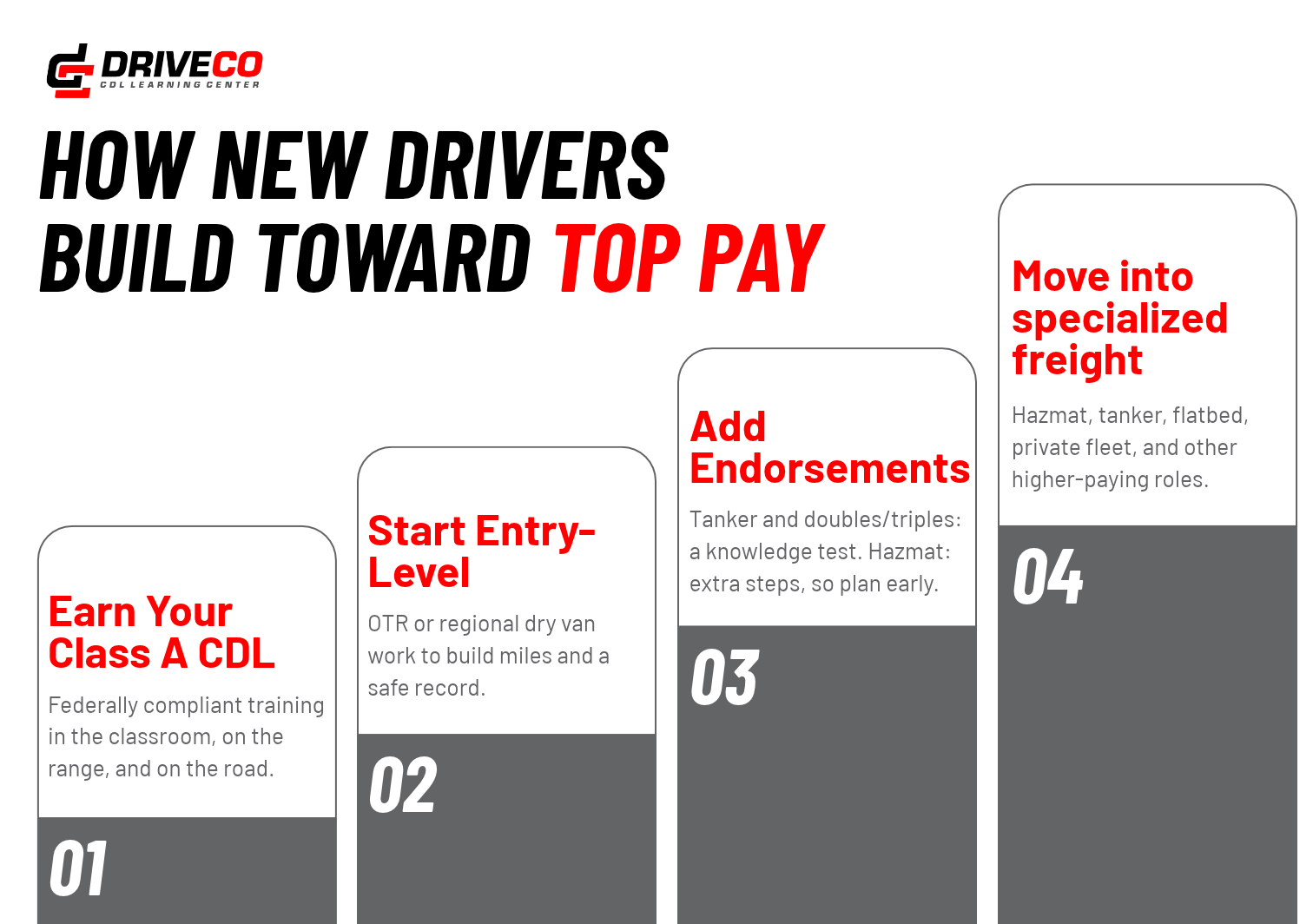
Most drivers do not start in the highest-paying jobs, but many reach them within a few years by following a clear path.
- Earn a Class A CDL. First-time Class A drivers must complete training that meets federal Entry-Level Driver Training rules. DriveCo’s Class A CDL training covers classroom, range, and road skills.
- Start with an entry-level job. Once drivers finish training and pass the CDL exam, many begin with OTR or regional dry van work to build miles and a safe record.
- Add endorsements. Tanker and doubles/triples need only a knowledge test. Hazmat takes more steps, so drivers often plan for it early.
- Move into specialized freight. With experience and endorsements, drivers can apply for hazmat, tanker, flatbed, private fleet, and other higher-paying roles.
DriveCo’s job placement support connects graduates with carriers that haul many kinds of freight. Trucking partners include Schneider, Werner, TMC Transportation, Gypsum Express, and Meyer Logistics. Each carrier sets its own pay, routes, and hiring rules.
Students worried about cost can review tuition assistance options. To get started, check the class schedule or contact DriveCo to talk with an admissions advisor.
Frequently Asked Questions
Do truck drivers get paid by the mile or by the hour?
It depends on the job. OTR and regional drivers are often paid by the mile, while many local drivers are paid by the hour.
How long does it take to reach top pay as a truck driver?
It varies, but many drivers move into higher-paying roles within a few years of safe driving. Adding endorsements and building a clean record can speed that up.
Do drivers have to be 21 to get the highest paying jobs?
For most of them, yes. Federal rules require drivers to be 21 to cross state lines or haul hazmat, so drivers under 21 in Indiana are limited to in-state routes.
Do company truck drivers get benefits?
Most full-time company drivers do. Common benefits include health insurance, paid time off, and retirement plans, though each carrier’s package is different.
Do bonuses count toward a truck driver’s total pay?
Yes. Many carriers offer sign-on, safety, and performance bonuses on top of base pay, though government wage data usually leaves them out.
Do Indiana truck drivers earn more than the national average?
Yes, slightly. Indiana’s median wage for tractor-trailer drivers sits a little above the national median, and the state’s low flat income tax helps that pay go further.
Can someone earn a good living in trucking without a college degree?
Yes. Trucking requires a CDL rather than a degree, and most CDL programs take only a few weeks to complete.